

The Second Iran War, Part 2
What has my life been like during this time?

I was in synagogue on Shabbat, Saturday February 28, 2026, when an alarm sounded. We had not had an alarm since the ceasefire with Hezbollah in November 2024. At my synagogue we were about to remove the Torah scroll from the ark, the cabinet in which it is held, for the Torah reading. The minute the alarm started, the prayer leader stopped. We looked at each other for maybe 2 or 3 seconds and quietly filed to the stairs and descended to the basement.
Alerts and Alarms
An alert is sounded on the cellphone of anyone with the civil defense app. It says to prepare for attack. Where I live, the alarm will sound between 5 and 10 minutes after the alert.
An alarm means “missile or drone on the way.” It sounds both on the phone and also outside. Where I live we have 5 seconds (you read that right) from the start of the alarm to impact, if we are indeed in the trajectory.
Frequent alarms during the active part of the Hezbollah-Israel war taught us that our alarm was short. We live so close to the border with Lebanon that we have just 5 seconds from the time an incoming missile is launched until it will hit, so as soon as the alarm begins we rush to safety.
That alarm in the synagogue went on and on.
After a couple of minutes, we returned to the sanctuary. Now, on the Sabbath we do not turn on (or off) anything that uses electricity except to save a life. This meant that although no one had been using their cellphone, any medical people on call, including doctors and emergency workers, had phones that were charged and turned on. By the time we had returned, someone had learned what was going on.
Before resuming the religious service, the rabbi announced that Israel was at war: we had attacked Iran. We would complete the service, but quickly. We were then to return home and not go out: we needed to stay near a shelter.
Anyone following this blog since the war began will know that I do not have a shelter. When we have alarms from Hezbollah’s attacks, I am to close all the doors to the long hall in my apartment and sit at the end for ten minutes. This is how long it takes for shrapnel from missiles blown up by the Iron Dome to fall to earth, the dangerous time. Outside of the massacres of October 7, most injuries to Israeli civilians during the Hezbollah portion of the war were caused by shrapnel.
But now we are dealing with Iran, which has much more sophisticated weaponry: guided as well as unguided missiles, all of which carry warheads that explode on impact, start fires, and deliberately spray out vast amounts of deadly shrapnel. Because of the distance, these take 10-15 minutes to arrive and our defense forces cannot tell exactly where they will land until about 10 seconds before impact.i We receive an alert when the missiles are sent: you have less than 10 minutes to get to your shelter, so put on your shoes and go now.ii
Since Hezbollah joined Iran in this war, we get both kinds of alarms. Type one is two sounds: the alert telling us that an alarm is imminent followed by the alarm itself. The second is the sudden alarm that says Hezzy has sent us presents, and we need immediate cover.
Day 1
Part 1 on this second Iran wardetailed the significance of the date: the Sabbath when we read Parshat Zachor as part of the Torah reading, so I will not repeat that here.
I live a 6-minute walk from the synagogue. The home where I was expected for the Sabbath meal was a ten-minute walk from my apartment, farther from the synagogue. I knew I could not go. I had not prepared a meal, but my hostess for Friday night’s meal had pressed leftovers on me. I would not be able to heat them up, so I was facing cold meatballs, rice, and beans. Then the woman who sits across the aisle from me, a widow and one of my first friends in Israel, invited me.
We hurried to her house after the service. Since we weren’t expecting an emergency that day (we all thought the war would begin on the Purim festivaliii) her saferoom was dark except for a little light creeping around the tightly-closed window.
One of her daughters arrived with her family. We made the special Sabbath table blessings and almost immediately an alarm sounded. Without a turned-on cell phone we didn’t get an alert, if there was one. We rushed to the saferoom, recited Psalm 121iv, and waited ten minutes in the dark.
Did I mention that our enemies love to irritate us? This alarm, and the four or five (I lost count) following, fell exactly during the 1.5 hours that would be mealtime for the vast majority of synagogue-goers. Then thankfully we had a long stretch of quiet. That daughter and her family went home; they have a saferoom.
Shortly after they left we had another alarm. A few minutes after the all-clear, another daughter and family, whose apartment doesn’t have a saferoom, came. They came planning to stay the night. They told us that when that alarm had sounded they had been on the steps of their building, starting to come. Instead, they went the short distance to the public shelter, staying there until it was safe to leave.
During the 12 days of the first Iran War I had stayed with good friends who live in the same neighborhood.v My friends and I had already decided I would return there when hostilities with Iran resumed. So around 4 pm my hostess walked me over, showing me a short cut that reduced the length of the walk by half.
Becoming an Evacuee
As soon as the Sabbath ended, one of the family members drove me to my neighborhood to collect my dog and whatever I would need for a few days. We had an alert just as we pulled into the parking lot, but at the top of the steps, halfway to my apartment, was a public shelter. When I got there several people were bringing their leashed dogs inside while others waited outside for the alarm. We stood there for more than 10 minutes waiting for an alarm that did not come. I took off for my apartment.
The suddenness of the alarm got my adrenaline flowing. I grabbed my little overnight bag and followed my mental list: enough underwear for four or five days, tops and skirts that I could mix and match, nightwear, etc. I grabbed the bag for my laptop, which was resting on top of the big suitcase I bought at the beginning of the war in case I had to evacuate from my town.
It didn’t occur to me until I was on my way back to the car, on the next-to-last step (past the public shelter where I waited on the way up), with my little overnight bag, the computer bag, and a small duffel, that I was evacuating my home. I should have taken the big suitcase and more clothing.
This was my second evacuation; the first was the 12-day First Iran War. That time, it never—NEVER—occurred to me to use that big suitcase. This time, it occurred to me too late to take it; I wasn’t about to drag the dog, suitcase, duffel and computer bag back up about 60 steps and the long path, repack, and drag the big bag and dog back down to the street.
But the truth: I am an evacuee. Granted, I am close to home, but my home is not safe at this time.
Public Shelters
Public shelters are common, but they were built for a different threat. They have toilets, sinks, and a shower. Many of these have a children’s play area outside, with a few benches. In those days warnings were only when attacks were imminent. There was then no Iron Dome to blow missiles apart in the air. Older people remember spending hours and sometimes days in and near these.
Between wars, many of these have been rented out. In my neighborhood, two are synagogues and two are gyms. But when there is danger, they are opened to the public. I have heard it is law that if during an alert or alarm there is no public shelter in the immediate area and a stranger comes to the door seeking refuge, they must be allowed in, even if they bring a leashed dog.
I have read how spending time in a public shelter can draw neighbors together. This may be true of shelters in homogeneous neighborhoods. But I live in a community that is home to many kinds of people, Jews and non-Jews. It was built in the 1990s specifically to provide housing for some of the million Jews and non-Jewish family members who escaped when the Soviet Union fell.
In the public shelter nearest to my apartment, people congregate with people from their group or their families. I am the only native English-speaker in the neighborhood. And I have no family. Everyone is cordial, but I am not part of any conversation group. Plus, by the time I get my 80-year-old body out of bed, find my glasses, slippers and robe, and leash the dog, I would have to dash to get to the public shelter in time. It is not comfortable and really not safe for me.
Saferooms
A saferoom is a reinforced room which in most cases will protect whoever is inside. In many buildings, owners voted to convert certain rooms (in a stack) to saferooms. People owning private or row houses who have enough yard space often have them built from ground up. The permit system could take up to two years in my area before construction could begin; at the start of the war permitting was expedited and now takes just days and costs much less.
The saferoom where I am staying has a full-size bed, a sofa, a pile of thin foam mattresses, and a number of heavy blanket-filled duvets. On one wall are bookcases with games and puzzles. The one where I spend most of the Sabbath day noon hour was a workshop filled with a drill press, workbench, and boxes with other tools and materials. One woman I know uses her saferoom as a sewing room. They may also be used as home offices, laundry rooms, craft rooms, guest rooms, or bedrooms.
Many families say psalms, or at least one psalm (I’ve heard both 20 and 121 are popular), when they enter their saferoom. I have a psalm app on my phone and often recite some while waiting. Some families sing, tell or read stories, watch TV, and so forth. On Purim day, someone brought and played a drummed while we sang and the littlest ones danced.
Solitude and Company
Being alone at a time like this is hard; people find ways to cope.
Children
Keeping kids occupied is of major importance. Since the Corona teachers and students are used to zoom classes, which now are often managed on smartphones. But now they are not full days, rather just an hour or so of check-in time. These provide a little structure and the ability to visit briefly with the children and adults with whom kids spend many of their waking hours.
During this time, the home where I am is housing 7 adults, 3 teens, and 3 children under 9, plus one 13-pound Italian greyhound mix dog.
My dog is a distraction for us all, especially the children. Before I adopted her she lived with a large family. Now she lives with me and two cats. She and I are accustomed to walking for about an hour daily: two long and one short walk. Those long walks aren’t possible now, but the kids like playing with her.
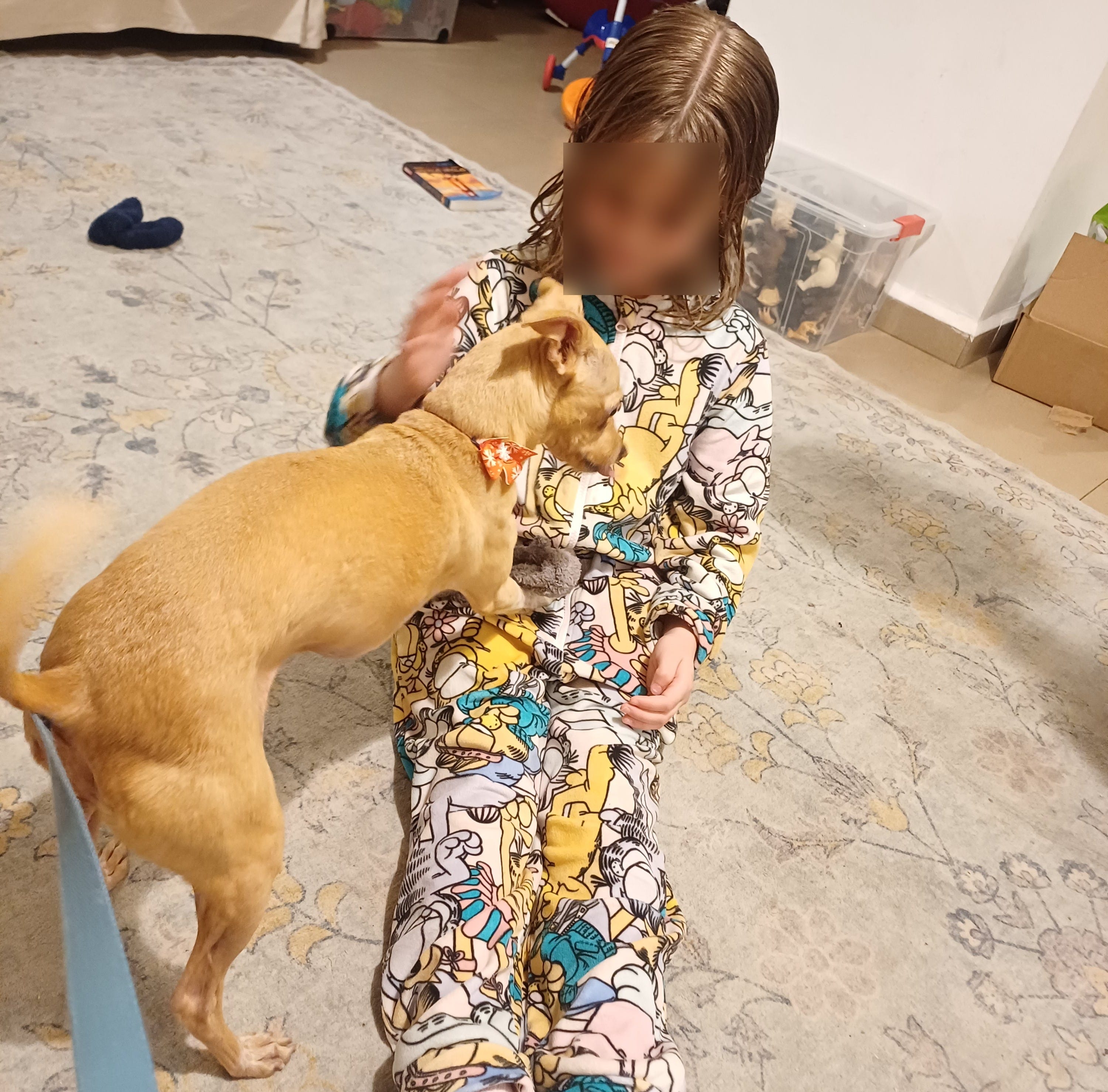
Today a third-grade girl, Roni, and I sat on the sofa for an hour using two game apps on my phone—one English word games and one Hebrew. We did one round in one language, then did a round in the other. Yesterday, Roni’s not-quite-five-year-old brother told me the Hebrew names of many of his plastic animals, including a large array of dinosaurs.
I finally learned the popular Israeli game Rumikub, which Roni taught me, as well as another game. Like many Israeli children’s games, the purpose is to complete a task, not for one person to win but rather to cooperate. I like games where there is plenty of laughter and no winners and losers.vi
Adult Visiting
We are pretty much confined by circumstances to a very small place, but that does not mean being alone. Sunday night we had a big dinner with the next-door neighbors. With all the kids and grandkids and me we were 25. Hamburgers were done on a charcoal grill while fries were made from scratch. Every possible topping was on the table. During and after the meal we sang patriotic songs. A big speaker had many playlists, including one with Israeli “golden oldies.”
Purim afternoon a festive meal with friends is traditional. I had planned to be at my friend Rivka’s; she had invited several others for a potluck at 3 pm. My hostess where I am staying planned for her friends to come at 1:00. So I had two parties.
At the first, we ate and sang. The speaker blared out holiday songs for awhile. Later one of the men drummed; the youngest child pounded on the table to help. It was raucus and fun.
We had one alarm/alert—at 2:45, right in the middle of party time. (I told you they like to disrupt our lives.) As soon as the all-clear came I left for the second party. This party—one English family and the rest American—was more sedate. Music was provided by the neighbors; we finally closed the window for relief.
Last night a nephew of my host was here for an hour or two. The father of three small children, he was called up to reserve duty. He brought a load of laundry in from the field, picked up some of the goodies from mishloach manot (explained in this story), visited awhile, and when his laundry was done went back to his base.
Conclusion
Visiting neighbors, sharing meals, singing, telling stories, playing and praying together—all of these provide not just distraction but also a veneer of normality to our lives. I wrote a lot about resilience in Part 1 earlier this week.
This is life in Israel. Everyone has his or her own story of these days. Mine is lived in a community where most people have lived in the same home for 20 or 30 years, families have grown up together and often married within the community. We are deeply religious people whose faith helps give us strength during these times. But it is also true that the civic culture is one of cooperation and nationhood. All of these give us the strength to live in this difficult Middle East.
May this war be successful. May a new regime in Iran arise that will work for cooperation with Israel, and may the hate supported both financially and in every other way by the government of the Islamic Revolution of Iran be discarded forever into the trash can of history.
i To understand this, think of a wedge of pizza. The point of the pizza is like the launching point of the missile. The farther from this point, the wider the piece of pizza, or the targeted area. Exactness cannot be traced as well as it can on a missile from Hezbollah, where only a few kilometers may separate launch pad and point of impact.
ii During the Hezbollah part of the war countless people ran to safety dripping from the shower with just a towel around them. Amazingly, there was a bump in births following this part of the war, in spite of these interruptions.
iii Our enemies have a pattern of attacking on our holidays. Within living memory, those have included the destruction of the Warsaw Ghetto on the eve of Passover 1943; the Yom Kippur war 1973; October 7, both Sabbath and Simchat Torah, 2023.
iv Psalm 121:
1) A song of ascents. I lift my eyes to the mountains from where will my help come?
2)My help will come from the Lord, maker of heaven and earth.
3)He will not let your foot falter; your guardian does not slumber
4) Indeed, neither slumbers [naps] nor sleeps, the Guardian of Israel.
5) The Lord is your guardian; the Lord is your protective shade at your right hand.
6) The sun will not harm you by day, nor the moon by night,
7) The Lord will guard you rom all evil: He will guard your soul.
8) The Lord will guard your going and your coming from now and for all time. (Psalms, Ohel Yosef Yitzchak, Kehot Publication Society, New York, 2020.)
v One benefit of not riding on the Sabbath is that we tend to live close together. This is called by antisemites “clannishness.”
vi I support competition when skill is involved, but not in games that depend on “chance.” I do not believe in pure chance; in my experience people have different amounts of luck and this is beyond their control. To this day, when I play board games I land on squares where I have to pay out, go back, or miss a turn about 5 out of 6 turns. The last time I played with my sister she didn’t believe it so started keeping track. Finally she said, “I always thought you were a sore loser, but you really do have the worst luck I’ve ever seen.”
Very realistic. Similar to what we went through.