


We Israelis are back at war.
Well, honestly we knew the war hadn’t ended; we still have men and women in Gaza and the north, as well as those searching out terrorists in Judea and the Shomron—the infamous West Bank to the outside world. But for families who don’t have sons and daughters serving in the army at this time, during the last eight months the war wasn’t top of mind.
This time, a mere eight months after we seriously damaged Iran’s military capability, they rebuilt stronger than ever. Their missiles are faster—formerly they took about 15 minutes to reach us and now they take about 10 minutes. This gives us less time to get to safety between the warning and the “incoming” alarm.
The missiles are also stronger. They carry exploding warheads that create damage from shock waves from the explosion, start fires, and spread large amounts of shrapnel (scrap). They are also guided, whereas the vast majority of Hezbollah’s are not.
It’s important to note that the effort and expense of this Iranian weapons build-up has had a significant impact on the daily lives of Iranians. Citizens are suffering from water shortages and power shutdowns, extremely high prices and not much to buy, and even greater repression than previously. Just as in Gaza, all resources have gone in the effort to destroy us, not to support its citizens.i,ii
The Start of This War
A word about traditional Judaism: on the Sabbath and the major holidays we do not touch anything that requires turning electricity on or off. This means the only folks carrying phones were those who were on-call (doctors and volunteers of the emergency medical organization, Hatzalah).
Around 8:25 am on Saturday, when I and many others were in the synagogue praying the morning service, a siren went off, startling all of us. We immediately took the stairs to the basement of the synagogue building. But the siren went on and on. After the Hezbollah portion of the war, when northern Israel was bombarded by rockets, we got very used to a short alarm.
This was much, much longer: clearly something else. We went back upstairs, and the rabbi reported that we were at war. We would complete the service and then we were to return home as quickly as possible and, if we didn’t have an in-home safe room, stay near a communal shelter.
Many attacks against us have been on holidays. Just within the memories of people still alive today are: the attack on the Warsaw Ghetto during World War II on Passover 1943; Yom Kippur War on the Day of Atonement 1973; the October 7 war on a day that was both Sabbath and Simchat Torah, a holiday whose name means literally “Rejoicing because of the Torah” 2023. Because the talks between Iran, Israel and the USA were held so close to our holiday of Purim, we assumed that this war would begin on that day.
Purim celebrates the time that we weren’t massacred. A time when the Amalek of that generation was destroyed before his genocidal plan could be launched.
What we did not expect was that the war would begin on the day we read Parshat Zachor.
Amalek
Those who study the Five Books of Moses will remember that Amalek was a king whose army attacked the Jews from behind as they fled Egypt. We had not gone near his territory; we had absolutely no quarrel with him, his nation, or his people. He attacked with the intent to destroy us just because he thought he could. He was the first antisemite.
History has been replete with others who have tried to destroy us. We believe that the big-name enemies of the Jews are incarnations of Amalek—either by blood or by spirit. Besides the Biblical Amalek, there was Haman, whose downfall is remembered in the Jewish festival of Purim, which this year begins tonight (March 2), and certainly Khameni, whose name is so similar to Haman’s.
The connection between Hitler and Haman was brought to sharp focus by the result of the Nuremberg Trials, when 13 of Hitler’s top echelon involved in the effort to destroy the Jews, as well as other war criminals, were tried. The last words of Julius Streicher, founder and publisher of the antisemitic propaganda newspaper Der Sturmer, before he was hanged, were “Purim Fest 1946.” He clearly saw that he had been a modern Haman.iii
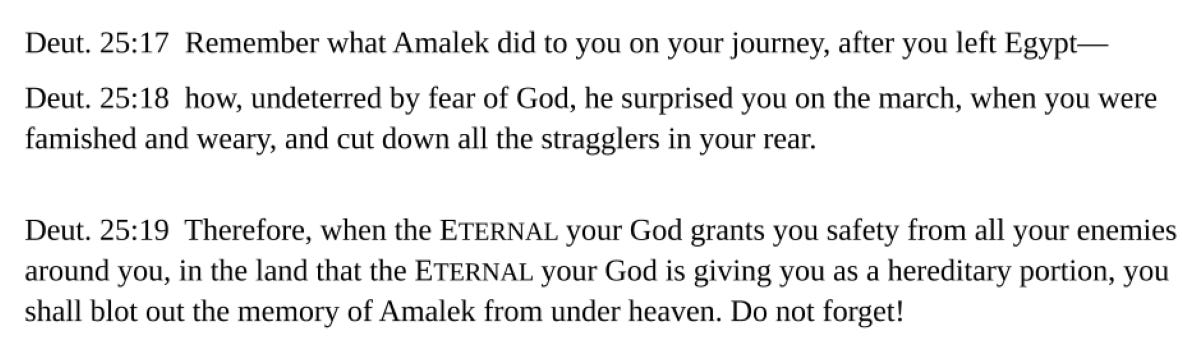
On the Sabbath before Purim we add to our Torah reading the three verses from Deuteronomy that instruct us to remember Amalek. Deuteronomy 25:17-19, called “Parshat Zachor,” remind us not to be taken by surprise again, to be aware even when times are good that there are those who hate us. As Miguel Cervantes wrote in Don Quixote: “Forewarned, forearmed; to be prepared is half the victory”.
Parshat Zachor is so important that besides reading these lines at the end of the complete portion reading, the brief passage is repeated following the regular service. Late-comers who missed it during its regular reading have the opportunity to hear it then. Many women, who are not obligated to pray in synagogue, come just for those few minutes. That is how important these three lines are.
Resilience
For most of the last 2000 years,iv Jews held absolutely no political power. Although as a people we have been powerless, our children have been raised to be resilient and to not take antisemitism personally. Our Passover seder, the service read around the dining table, includes the following:
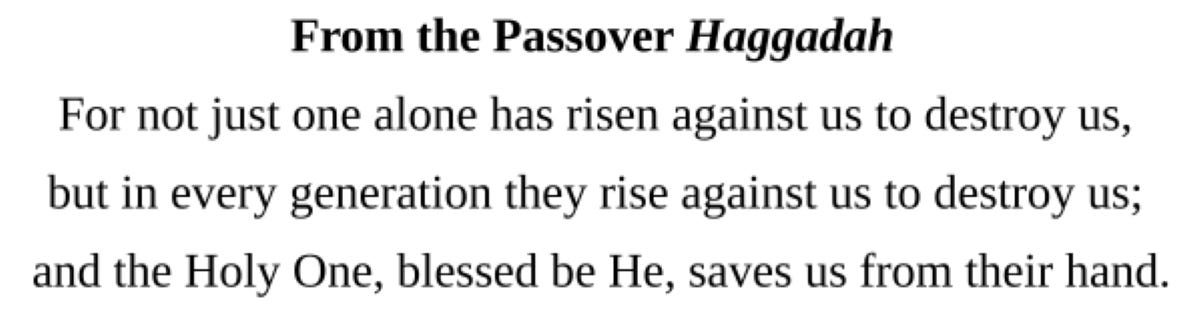
Jewish children learn in earliest childhood that being picked on because of our origins is not personal. As a people, we have no patience for the victim mentality. We are survivors. Within 10 years of the liberation of the concentration camps, many former inmates had rebuilt their lives and started successful businesses in the USA and other places, including Israel. Refugees from the Arab lands also built strong new lives although having arrived in Israel with just the clothes on their backs and, if lucky, one small suitcase.
Tragically, yesterday one Iranian missile struck a synagogue in a city called Bet Shemesh yesterday, killing 9 and injuring many more. Bet Shemesh, it is important for westerners to know, is predominantly populated by Americans.
Bet Shemesh was not an accidental missile strike. It was a deliberate targeting that gave Iran a twofer: they killed Israeli-Americans (American-Israelis). Citizens of the Big Satan along with those of the Little Satan.
To Be…
I had intended to write about daily life during this national emergency, but as I started I realized there were too many things that non-Israelis, especially non-Jews, needed to understand. If all goes well, the day after tomorrow I will publish an essay about living through this. A second follow-up piece will be my answer to the so-called newsman who was interviewed by American ambassador to Israel Mike Huckabee in the Israeli international airport last week.
i As I wrote this paragraph, we got a warning to move toward a shelter. If and when the attack is imminent, we will get the attack siren and rush to a protected place. Think of a piece of pizza, a point at one end and a large piece of crust. Iran is the point, we are the crust, and when the missiles are still near the point it’s too early to say where in the crust they will land. The warning is when we know they’ve gone out, the attack alarm is if and when our defenses know our small area will be the recipient.
ii https://www.ncr-iran.org/en/news/economy/irans-regime-faces-mounting-economic-collapse-as-prices-soar-and-capital-flees/
iii Last week’s Sabbath newsletter from the publisher Artscroll/Mesorah included a fascinating, brief article about the Nazi connection to Purim on page two of their newsletter, https://blog.artscroll.com/wp-content/uploads/2026/02/artscroll-shabbos-newsletter_tetzaveh5786_pgs.pdf
iv Nearly 2000 years have passed between the destruction of the Second Temple and enslavement/population transfer by the Romans of Jews to Italy as slaves, and the establishment of modern Israel. Jews living in Europe were subject to Christian persecution. The term “wandering Jews” is because in Europe we were thrown out of one locality after another. After years or generations we were were allowed back in, often to be thrown out again a few generations later. Jews living in North Africa and the Middle East were subjected to Islamic repression. Many of them lived in the villages and cities of their ancestors; some still have family stories of having lived in a particular city in what is now Iran, Afghanistan, Tunisia for 2,000 years. Some know their regional roots were planted after the destruction of the First Temple in 586 BCE, approximately 2600 years ago. Others know that their families settled in their places after the Expulsion from Spain in 1492, a “mere” 534 years ago. Those in Europe are mostly Ashkenazi; those who found new homes following the Spanish Expulsion are Sephardi; and those whose families found new homes in North Africa/Middle East 1500 years earlier are called Mizrachi. There are others, such as Yeminite. Paul Johnson’s History of the Jews is the best recent history of my people, although first published in 1987.
As always, your reporting is fabulous. I appreciate your take on how things are in Israel. There is so much fake news here and congress is now going on vacation. I'll keep my comments to myself on that issue. We on the right know the Iranians can't be trusted and I suspect
russia has a lot to do with that!
👍👍👍