


In the weeks before the schools here closed for summer vacation, I went to two end-of-term recitals at my town’s music school: one for the students involved in the Bet Musika-Elementary School joint music education program and one for private students who are mostly in their teens. I have a special fondness for this facility.
The Bet Musika (Music School), a short walk from my home, was the first public building I entered in this community, and it holds a special place in my heart. Three weeks earlier, just before the Jewish New Year, I had arrived at my new home in Israel. The New Year begins a three-week period of holy days and sabbaths, with the intermediate days of the 8-day holiday of Sukkot filled with entertainment for kids and activities for everyone.
I, however, spent all the non-holy days shopping for necessities and traveling to government offices in nearby cities. A government snafu had left me in immigration limbo and temporarily unable to get an identity card. Without the card I could not open a bank account, nor could I receive the shipment of belongings from my Idaho home. It would be, I was told, between six weeks and six months before my status would be regularized and I could do all the things that most immigrants can do the day they arrive. This meant that I needed to buy a lot of things needed for daily living that I’d carefully packed and shipped. I had to do this with the limited vocabulary I still had from the year and a half I’d spent in Israel after college, 49 years earlier.
I was exhausted, slightly disoriented, and desperately in need of something to lift my spirits.
Then I saw a flyer with a familiar name: Shlomo Carlebach,i who passed away in 1994. A local band was going to play songs and instrumental music by this noted rabbi and musician.
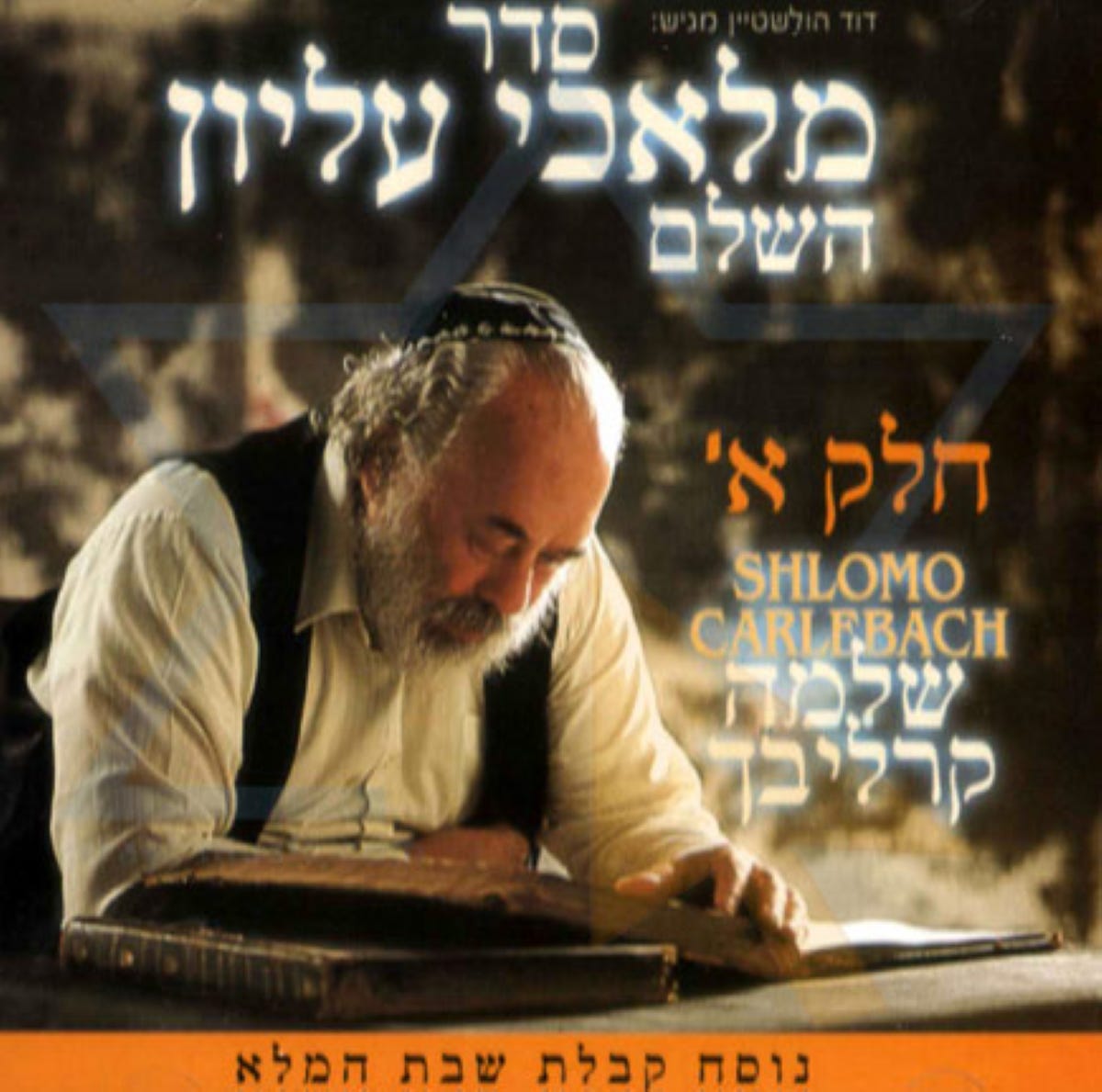
I saw Rabbi Carlebach in person three times—twice in the mid-1960s and once in 1989. He wove music and stories together in a way that drew me to traditional Judaism. The concert was free; it was at the Bet Musika, which I realized I passed whenever I walked to the nearby shopping center.
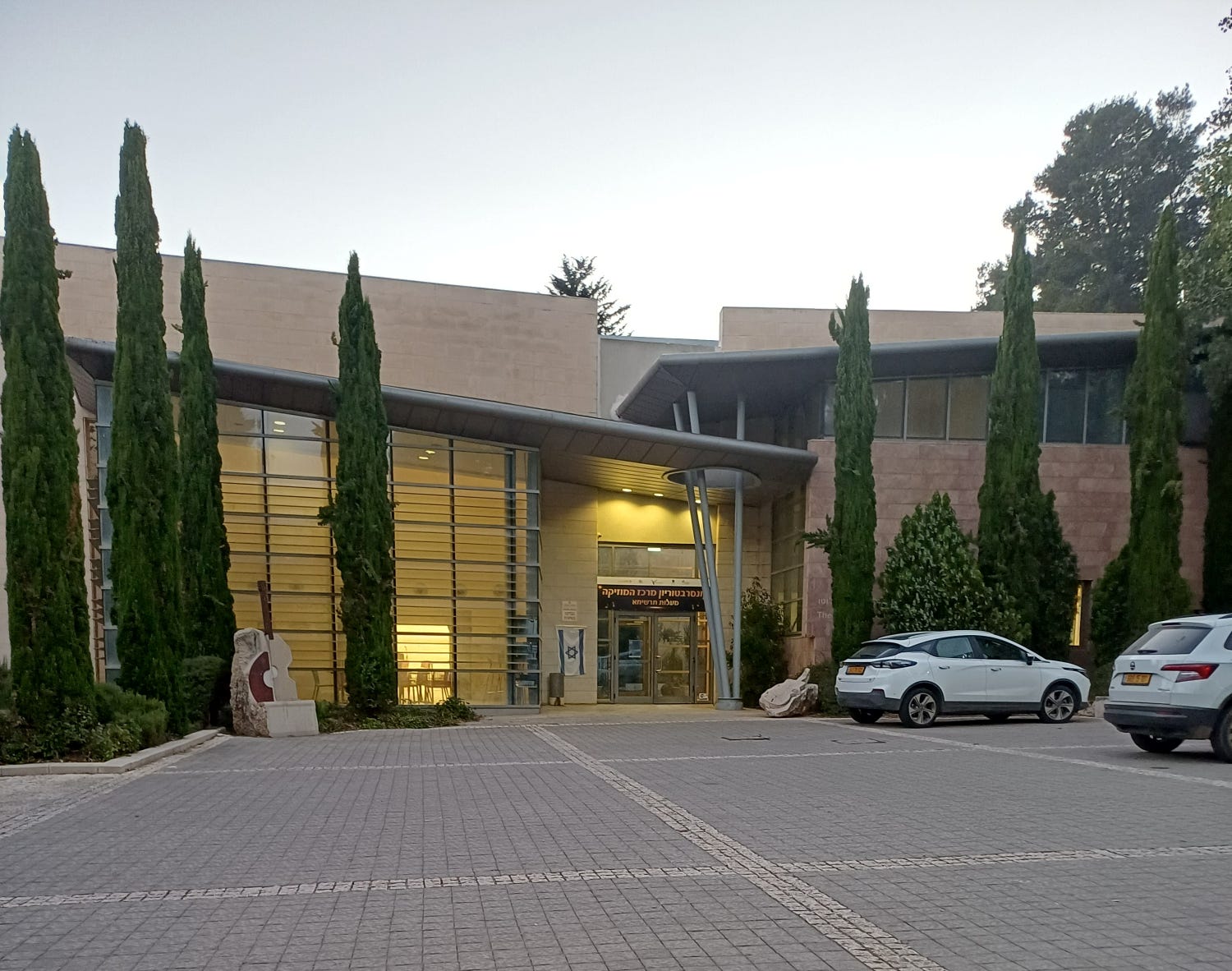
The concert was called for 8 pm. I’m American; I got there a little before 8:00 and found an empty hall with a few workers setting up chairs. I wondered if I’d gotten the date or time wrong, but I hadn’t. This was my first experience with Israel Time. I sat down in an empty chair in the second row and pulled out my phone, which luckily had several books on it.
Around 8:20 family filed in and sat next to me. While I was looking around wondering why they’d chosen those seats in a nearly empty hall, the mother started talking to me. She had recognized me from synagogue and chose those seats because she could get my name and phone number. Writing is not permitted by Jewish law on the Sabbath or holy days, and she had wanted to invite this new resident for a meal. If you’ve been reading my essays long you know that we are “Am Yisrael,” the “People of Israel.” People, as in Same Tribe, as in One Family. This invitation, while unexpected, was not exactly a surprise. They were there because one of their sons was a member of the ensemble that was playing that night.
It was a great evening of familiar and unfamiliar music played beautifully by that group. More importantly, since that day I’ve become what, when I was a child, we called a courtesy relative: a friend so close to the whole family they are called “Grandma” or “Auntie” without blood ties.
That was the first of many events I have attended at the Bet Musika.
History
The Bet Musika is housed in a beautiful building built about 22 years ago. But some eight years before that, a group of music teachers started dreaming about having a formal community music school.
For those eight years, as undoubtedly in years before, music lessons were given by competent teachers to interested students. The school building, however, provided a place, a foundation, for the school.
After several years, the leadership began working to raise the level of education that it provided. In 2021 the school was recognized by the national Department of Education as a music conservatory, meeting the government’s exacting standards for that designation.
That recognition was important for several reasons. Firstly, being drawn under the national Department of Education made possible the close cooperation with the schools. Also, conservatories receive government stipends for instructor salaries. This proved very important for the Bet Musika. We are in the far north of Israel, a largely rural, mountainous area near the Lebanese border.ii It is hard to attract musicians to an area with a reputation for being attacked and few opportunities for the kinds of part-time salaried jobs or gigs that supplement the low incomes that most jobs for musicians bring.
The school has two part-time directors who have worked together for ten years. Gadi is administrative director responsible for budget, the building, liaison with the schools, and publicity . Eran is the musical director, responsible for hiring and supervising the teachers, developing curricula, and so forth.iii Eran told me that Gadi and he are very different superficially: one is religious and one is not, one is politically conservative and the other is progressive. They disagree about many things. But they agree on the importance of music and music education, and agree to disagree on other subjects.
Relationship with the Schools
There has always been a connection between the music school and the public schools, but it has been formalized since the government’s recognition. All five of Maalot’s elementary schools participate in the Bet Musika’s program, which includes three levels totaling about 150 students.
The beginning level is free except for rental of the instruments. The music classes are held once a week, in the schools on school time. The beginning program offers five options: clarinet, flute, recorder, violin, and classical guitar. Eran, who for several years has taught one half-day a week in Safed, a city about 45 minutes away, ran a pilot program there of teaching harmony through the harmonica, and found it so successful that he is including it in the Beginning program next fall.
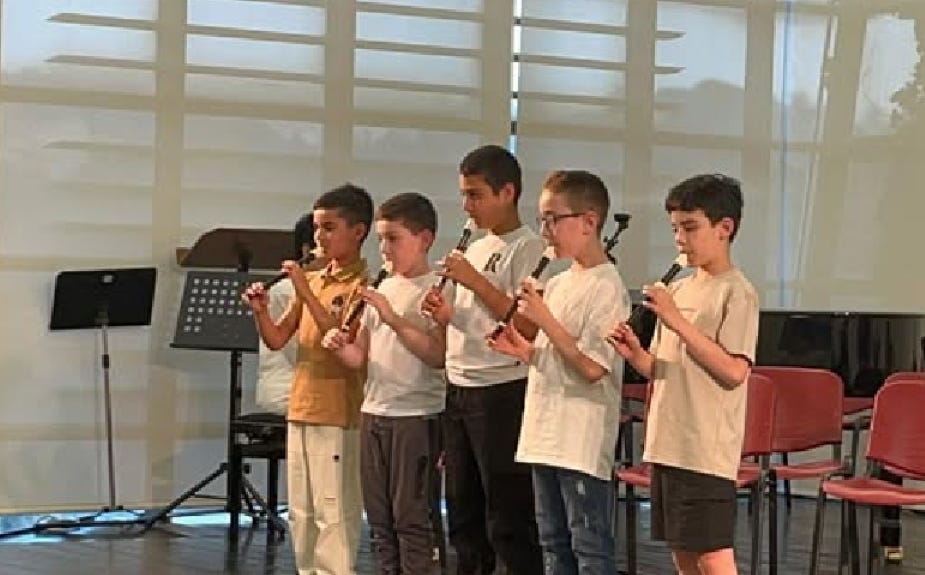
Besides learning to play their instruments and basic music theory, children are taught customs of music. Israel is made up of people from more than 90 countries including many non-western people; in our 3000-year-history Jews have moved all over the globe including to Africa and remote parts of Asia. Lessons in music cultural literacy teachers the children how, for example, classical music audiences behave and other things that the children need to understand in order to feel comfortable in all sorts of musical events.
The Bridge Program is a one-year program in which students who have completed the Beginning level study in small groups, generally up to four students. Following that, the talented, motivated students can study privately in more depth, including music theory, harmony, and other aspects of music. Some teens receive scholarships for private lessons.
High school-age students can work for the bagrut in music—a national “final exam” that is part of every student’s school record. A few years ago I attended a flute recital that was also the musician’s bagrut exam. The level was very, very high.
What impresses me every time I go to a student recital at the Bet Musika is the calm of students who get lost in the middle of a piece they are playing. Stage fright is natural; even many professional musicians experience it, and at these recitals the children and teens may be playing for a large audience for the first time ever. The students I’ve seen who have gotten lost or forgot what comes next—and I’ve seen several—seem to take a deep breath or two, go back or forward to a place where they can begin again, and continue playing. Their poise in these trying situations is remarkable, and speaks of the positive, respectful attitude toward music, music lessons, performing, and the other students that they absorb from their teachers and the school as a whole.
Diversity
Maalot-Tarshiha, my city, is made up of two parts—two steep hills separated by a narrow valley. Maalot was incorporated just 70 years ago and is primarily Jewish. Tarshiha is an ancient Christian Arab city that still maintains that character although also home to Muslims, Druze, Jews, and others.
The schools in Tarshiha focus their musical education on Arabic music, so they do not participate in the Bet Musika’s Beginning and Bridge programs. However, about 20-25% of Bet Musika’s private students are Arabs. They are completely integrated into the school’s programming.
The public schools in the Maalot section of town include both boys’ and girls’ religious schools as well as schools that are open to all students. Living in this part of the city are many people of Moroccan descent as well as those from other North African communities whose families were thrown out of those homes after the establishment of Israel; Russians, both Jewish and ethnic Russian; Bene Menashe people from northeastern India near the border of Myanmar (Burma), a small number of Ethiopian Jews, Anglos (from English-speaking countries), French, Spanish-speakers, Brazilians, and others. All the schools have students from all these backgrounds, and the classes at the Bet Musika reflect this diversity.
Besides student lessons, the building has piano practice rooms that are open to the public for free on weekday mornings. The concert hall is also used for concerts and other functions, many from visiting groups.
The War and the Bet Musika
All schools in this area were closed for about 2 ½ months this year because of the war. During this time the Beginning and Bridge programs could not be held normally. Instead, about half the student studied on Zoom, which is less effective than in-person teaching but better than nothing. Forty percent of students paid for private lessons where their teachers went to their homes. Only ten percent canceled.
Eran said that since the war there has been less motivation among children to participate in group lessons. Some 20% of the participants in group lessons dropped out, but the more motivated and talented private students continued to learn. In fact, the faculty’s consensus is that many children needed the music for their psychological health. Having to practice and play music not only gave them something to do; the music itself seemed to help them weather the uncertainties and dangers of frequent, random missile attacks.
Conclusion
If you are visiting Israel and coming to Maalot-Tarshiha, you can add in a visit to our Bet Musika. The staff is always happy to give tours of the building. An interesting, very Israeli fact: percussionists practice in the underground bomb shelter just outside the building so that the drums don’t bother the other students.
Also, a pitch: Eran would like to be able to give additional stipends to teachers who come from Haifa or the Tel Aviv area, making the long trip financially practical. We are a half-hour drive or 40-minute bus ride to the nearest train. Attracting good teachers to this area is the school’s biggest problem. Haifa, the nearest big city, takes at least 1.5 hours by public transportation (assuming one catches the train and bus promptly) and can take longer by car during rush hours. The pay provided is just for teaching hours and does not cover travel time. Please contact me privately through a Comment on this essay if you are interested in making a donation to the stipend fund.


i For information about Rabbi Carlebach, see https://rebshlomocarlebach-ztl.blogspot.com/2009/12/reb-shlomo-books.html . This is primarily an ad for a book about him and his music, but there is a little information also.
ii Israel is very small; most people live close to a national border or the sea, but besides living close to a border we are far from the population centers.
iii Using first names is not unusual, and that we call the Prime Minister “Bibi” is not an anomaly. Israelis do not stand much on formality.
*For many years, until the Corona (Covid-19), Maalot-Tarshiha hosted an international stone-cutting contest. These are some of the sculptures done during those events. Others can be found in public areas throughout the city.
Wonderful 🎻🎺🪗🎸🎹🎷🥁🪘🪕 I especially like how the drummers practice in the bomb shelter, lol!
I really appreciate your writing. It is well done and informative. Thank you for continuing to write through all the difficulties of the war. It's been fascinating, amazing, frightening, educational, and beautiful to read about your life and your survival. God bless you.