


Social media is full of whiners, complainers, and victims. Many of the complaints stem from jealousy or envy. For example, many antisemitic posts blame Jews for being successful. Jews must control the world, they say, or they wouldn’t receive so many Nobel prizes. Young, healthy-looking women with expensive-looking manicures and fake eyelashes record themselves from late-model SUVs, complaining that food stamps shouldn’t just be for healthy foods; snacks, sweets, and other empty calories should be provided courtesy of the (rich) taxpayers.
Jealousy and envy are antithetical to what Judaism teaches. The last of the Ten Commandments, thou shalt not covet,” addresses this. If these emotionsi weren’t a natural part of the human makeup, the Ten Commandments would not include them. That wording, however, is negative: what you shouldn’t do. Where do we learn what we should do?
As early as the first book of the Bible, Genesis, we find lessons about gratitude and plenty: the opposite of jealousy or envy. One example is the difficult life of the patriarch Jacob. At his mother’s urging and using trickery, he stole his brother Esau’s blessing and had to flee. He fell in love and worked 7 years for permission to marry his beloved. His father-in-law, Laban, tricked him into marrying her sister instead, and required another 7 years of work to finally marry his true love. Laban cheated him in other ways as well. Jacob finally took his wives, concubines, children, and herds and returned to his homeland. On the way, he met his estranged brother. Jacob gave Esau a very generous gift of livestock. Esau bragged, “I have enough.” Jacob replied, “I have plenty.ii”
“Enough” complements “not enough,” a common expression. There’s not enough milk for tomorrow’s breakfast. My pay isn’t enough for me to buy a new car. Your test score isn’t [good] enough to get an A. Esau’s “I have enough,” indicates that he counted the amount that he had.
On the other hand, I have never heard someone say “not plenty.” We use “plenty” often to indicate a sufficiency without suggesting it might not be “enough.” “I’ve got plenty of time.” “A small slice of cake will be plenty.” Jacob’s reply, “I have plenty,” indicates that the herd he had left after giving Esau a large portion was enough, maybe more than enough. Just a moment’s study of his life shows us that Jacob didn’t whine, complain, or consider himself a victim. He was satisfied with whatever he had.
The concept of being satisfied is taught many times in the Torah. One of the most famous teachings of Pirke Avotiii is, “Who is rich? The person who rejoices in his lot.” This phrase is just part of the teaching; it continues, “as it is said, You shall enjoy the fruit of your labors, you shall be happy and you shall prosper” (Psalms 128:2).iv
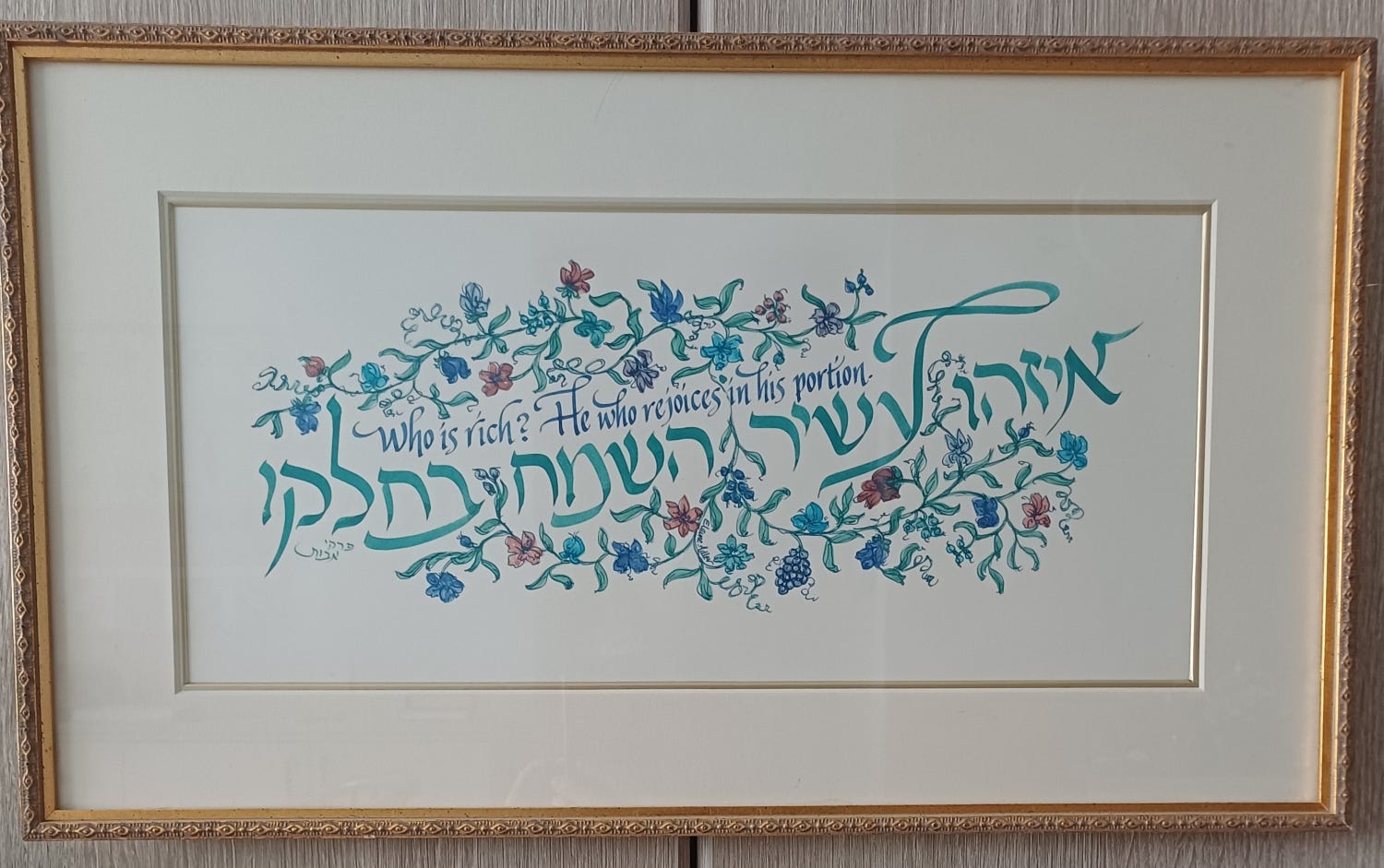
A person needs to be at a high spiritual level not to feel something negative when confronted by someone or something with more. When a person has not reached the spiritual level of “I have all I need,” he feels that something is missing and therefore lacks serenity. Lack—not having everything one needs or wants--is one of the primary causes of sadness,v according to Rabbi Menachem Mendel Hager of Kosov (1768-1825).vi On the other hand, those who have reached that level feel contentment. Those of us less perfect at least feel contentment when we are aware that what we have is “plenty.”
Israel and Happiness
Israel consistently falls into the list of the top ten happiest countries. In 2024, according to www.worldatlast/com, Israel dropped from 4th place to 5th place. This was just months after a ghastly terror attack in which the equivalent of around 35,000 Americans were killed and hundreds more wounded. It was in the middle of the country’s longest war, with over 250 residents held hostage in Gaza, a huge percentage of men and women from 18-45 serving active duty as a regular or reserve soldier, thousands of border-dwellers who were refugees within the country, and missiles flying into our land day and night.
How could we be happy? WorldAtlas.com says it’s because of a strong sense of community. While Israelis have a strong sense of community, it is also important to recognize that our Jewish culture teaches the concept of “plenty” over “enough.” Accepting what one has is a cornerstone of Israel’s dominant religion and a reason people are happy in spite of troubles.
Recently I was at a bat mitzvah party, a women-only party for Sapir,vii a young girl who reached the age of 12viii and is now, according to Jewish law, a woman responsible for following the commandments. Like many Israelis, the family struggles financially. The party reflected this: it was held in the small, simple social hall of a local synagogue. The family provided “mains,” while salads and desserts were provided by friends. The décor consisted of a large balloon construction, a rather inelegant golden carpet, and decorative napkins.

It was the opposite of the fancy sit-down dinner affairs I’ve been to where guests try to out-do each other in the garment-and-jewel department and even at the dining tables strangers do not talk. It was one of the best parties I’ve ever been to—full of conversation with old and new friends, laughter, and spirited dancing. Not to mention healthy food.
I have known the bat mitzvah family for six of the eight years I’ve been in Israel, and I have never heard any of them complain about having less than others. (They might occasionally complain about the landlord who doesn’t fix anything.) Like many people I know in this community, their friends share the attitude of “plenty.” When people are in the “plenty” mindset they can live and let live. This sense of contentment translates into the friendly “we’re all together celebrating” attitude that made the party so much fun.
A Woman Who Exemplified “Plenty”
This party also included a custom that I have seen at other women-only get-togethers: yeast dough is prepared so that the special women’s blessing on dough will be said. At Sapir’s bat mitzva party, challah dough was prepared. Then all the guests sat down and watched as the bat mitzvah girl separated a bit of the dough and made the blessing for the first time. The family then took the dough home, shaped it and baked it for the following Sabbath.ix
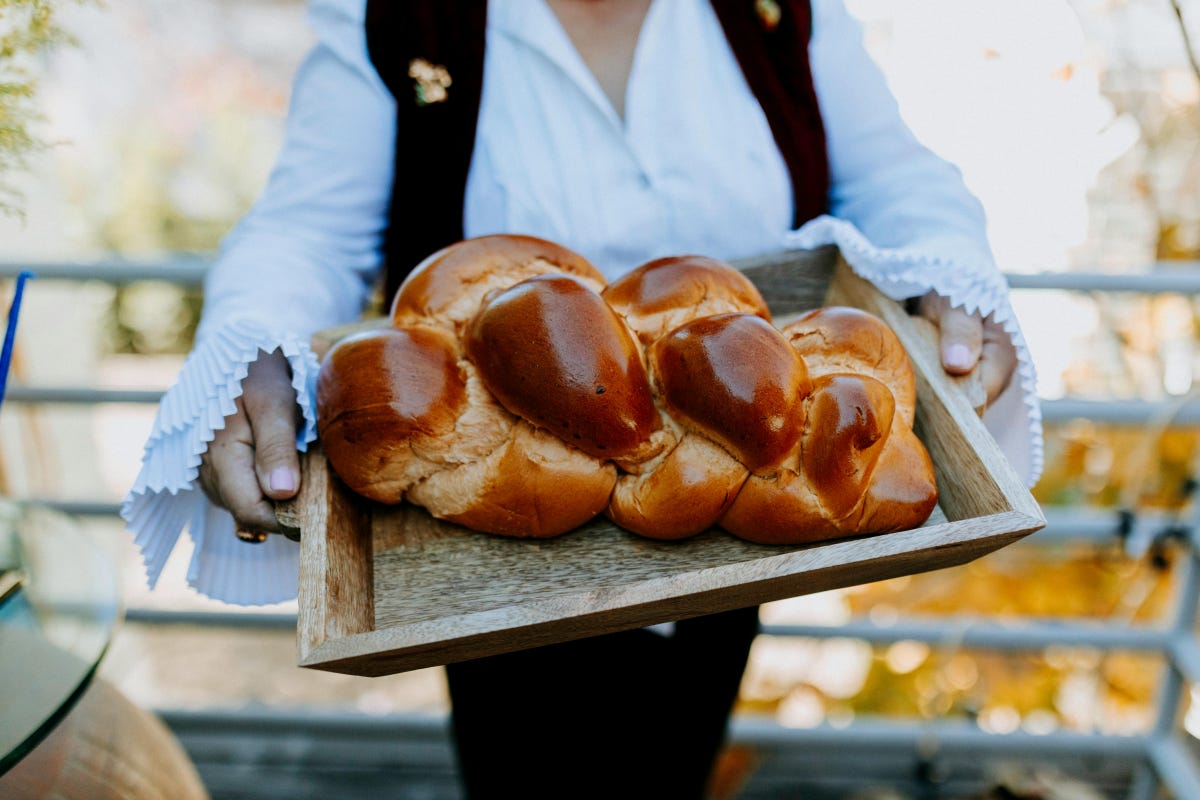
Watching Sapir take challah for the first time, I remembered the first woman I knew who took challah.
Julie was about 45 years older than me, but she was a frequent guest when I and my circle of younger adults shared Sabbath meals. What I knew about her boiled down to this: she had worked as a lab technician in a medical research laboratory in a city with a small Jewish community, she had never married, she was a vegetarian, and she always brought home-made challah for the Sabbath meals.
After a little over a year in her community I moved and began studying traditional Judaism. That was when I first learned about the mitzvah of challah. A few years after that I attended a conference in Julie’s city, and stayed with her. That was when I learned more of her story.
She was raised in Alsace, a region now in northeastern France but which was under German rule until her teen years when it was returned to France. She had attended a Jewish school and practiced traditional Judaism. She knew there were three mitzvot which were more important for women than for men. One was lighting Sabbath lights, one was observing the family purity laws,x and the third was “taking challah.”
Around that time, her mother’s sister, mother of a large family, was in poor health. At the age of 16 Julie was sent to help the aunt and uncle, who owned a general store in a small town in Oklahoma.xi Julie lived there for a number of years, learning English and attending high school. But in the small Oklahoma community where her aunt’s family lived, there was no Jewish community. Julie did her best to follow the Jewish laws. Kosher meat was not available, so she became a vegetarian. She continued to light candles in honor of Sabbaths and holidays and refused to date non-Jews, making the family purity laws irrelevant.
That left the third mitzvah for women, taking challah. A portion of any dough is taken in remembrance of the offerings when the Temple stood in Jerusalem. However, the blessing is only said when at least 5 pounds of flour (2.26 kg) is used. That is a lot of bread for one small woman to eat in a week. But taking challah and making the blessing was one thing she could do, even though she didn’t live near a synagogue and had no religious community.
To do this without waste, she began giving the bread away. She told me that she had a long list of recipients. One or two families with which she was very close received challah weekly. But most people she gifted just once a month, so they wouldn’t feel uncomfortable accepting it.
I realized that most, if not all, of the people receiving her challah did not know that this was one of the mitzvot that this woman had fulfilled diligently, with as much hiddur mitzvah as possible: enhancing it with beauty and special care.
Julie was “alone,” but she had, a huge family of people whom she treated with affection, many of whom, like me, loved her. By comparison with Sapir’s rich religious life, she had nothing. But she didn’t count like that. She had her “plenty.” She filled her “plenty,” the mission she had been given, with grace, generosity, and kindness.
Having plenty
Julie could have been an object of pity. She was at that time a 79-year-old childless, never-married woman on a small pension who had lived in the same small, old apartment for many years. Her only living family was a niece whom she hardly knew in a distant state. But she would have raised her eyebrows at anyone who dared to categorize her like this. She exemplified “plenty.”
The last time I saw her we just had time for a quick visit and lunch. I could only arrive around 11 am, and she was expected at 1:00 at the nursing home where she volunteered several afternoons a week. She visited as she said, “lonely old people who have no one.” She wouldn’t be home until 4:30 pm. I had to get to the airport by 5 pm, so we said goodbye after lunch.
But that morning I learned there was one thing she lacked. She showed me her treasures: a coverlet her mother had embroidered and the silver candlesticks her mother had given her before she left for America. In a kitchen cabinet, to get to something else she wanted me to see, she also pulled out a large plastic bowl. She said with a sigh, “This is the bowl I use to raise my challah dough. It doesn’t hold the heat as well as a ceramic bowl would, but it works.”
Think about this: The only thing Julie lacked was a ceramic bowl to help her fulfill the mitzvah of taking challah.
In the short time between lunch and 4:30, I found exactly the kind of bowl she needed, and gave it to her when she got home. I still made it to my plane with a few minutes to spare.
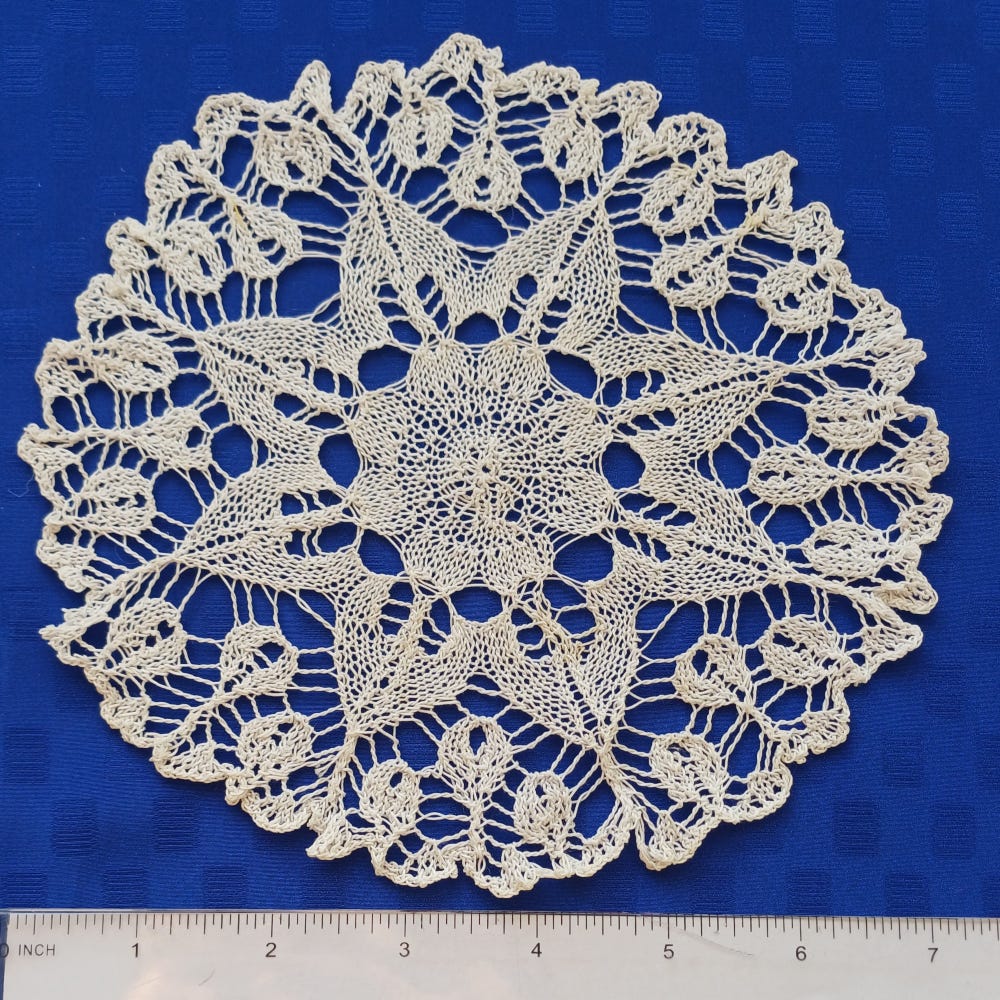
A few weeks later, Julie sent me a little gift. When she was young, her mother had sent her to the near-by convent to learn knitting and embroidery from the nuns. This is what she sent, a true labor of love from an elderly woman whose fingers were not as flexible as they’d been when she was 9 years old.
In the end...
In the end, the important question is not whether you or I take challah. The question is, do we accept our “plenty,” or do we dismiss it as not enough? Do we use our “plenty” just for ourselves, or are we generous? And are we grateful to our Creator for the “plenty” that we have been given?
In a world surrounded by people who are sure they do not have “enough,” let us strive to feel that what we have, whatever it is, is “plenty,” and let us share our plenty, and our understanding of plenty, with others.
i Hebrew has one word for both jealousy and envy. It also means zealousness.
ii Genesis 33:9-11, https://www.sefaria.org.il/Genesis.33.11?lang=en&aliyot=0&p2=Genesis.32.1&ven2=english|The_Contemporary_Torah,_Jewish_Publication_Society,_2006&lang2=en&aliyot2=0
iii Altein, Y., https://www.chabad.org/library/article_cdo/aid/6410436/jewish/12-Facts-You-Should-Know-About-Pirkei-Avot-Ethics-of-the-Fathers.htm
iv Pirke Avot 4, translated by Dr. Joshua Kulp, https://www.sefaria.org/Pirkei_Avot.4.1?lang=en
v Quoted in Rabbi David Chai Abuchatzeira on Emunah and Bitachon (on Faith and Trust), Adapted from the Hebrew by Rabbi Avrohom Wagner, edited by Mrs. Malky Heimowitz, pp. 137-138, Mesorah Publications, Ltd., New York, 2025.
vi Enai, G., The AhavadShalom: Charity, Covenant and Shabbat, Nov. 12, 2024, https://inner.org/the-ahavat-shalom-charity-covenant-and-shabbat/
vii The name Sapir means sapphire.
viii In the USA, liberal Jews, who celebrate egalitarianism in religion, celebrate the bat mitzvah at age 13, which is the age when boys become responsible for the the mitzvot. Since liberal Judaism is not concerned about the particulars of Jewish law, the change of date for girls is irrelevant.
ix There are three specific commandments that, while men can also do them, women have priority: lighting the Sabbath candles; following the family purity laws; and separating the first portion of dough as an offering.
x For an explanation of the family purity laws, see https://www.chabad.org/library/article_cdo/aid/465166/jewish/Mikvah-Jewish-Family-Purity.htm
xi “Jew Stores” were common throughout the south and midwest for many years. Jewish-owned wholesalers worked with new immigrants, refugees from the pogroms and wars in Europe, setting them up in business in small communities where shops were needed. These stores are described in the memoir, The Jew Store, a family memoir, by Stella Suberman, Algonquin Books of Chapel Hill, 2001. I have known several people whose families owned “Jew stores.” Minorities themselves, often their shops were boycotted by many of the whites; some were targeted by the Ku Klux Klan. In some places they were the only shops that served Black and Native American customers as well as whites. They were known for their honesty and charity, often extending credit and not collecting from widows, elderly, and disabled. The infrastructure that thriving Jewish communities need, like synagogues and kosher butchers, were not available (commandments between man and God), but these merchants usually lived by the commandments regulating relations between people, including using honest weights, paying bills promptly, and so forth.
What a wonderful lesson 🥰🥰🥰