

Part 1: An Incorrect Translation
How the mistranslation damaged Judaism in the USA

Honor is the part of you that recognizes truth, is drawn toward goodness, and calls you to become the person you were created to be.i This definition, written recently by my friend Scott Stephens, whose mission is to encourage men to be better men, husbands and fathers, got me thinking.
What, I asked myself, does Judaism say and do about the concepts of truth, goodness, and what we are created to be? How does or doesn’t this affect the world?
As a child in liberal Jewish Sunday school, I learned that Micah said that what God wants from us is to do justly, love mercy, and walk humbly with God, but I didn’t know exactly where he said that. A search for “what is the prophet Micah known for” turned up Micah 6:8 and the familiar quote. But the source Prof. Google gave me was a Christian bible. I went to Sefaria to check Jewish sources. To my shock, I found a very different quote: ...to do justice, love goodness, and walk modestly with your God.
I was so startled that I switched to the original Hebrew and found that this last was the correct translation. What I “knew” was actually an incorrect Christian translation of the original text.
The King James translation and the majority of Christian versions, as listed in www.biblehub.com, use, like the original, three characteristics. But these differ from the Hebrew. Instead of justice the majority use justly; instead of goodness the majority use mercy, with kindness running second. The words humbly and lowly are used instead of modestly.
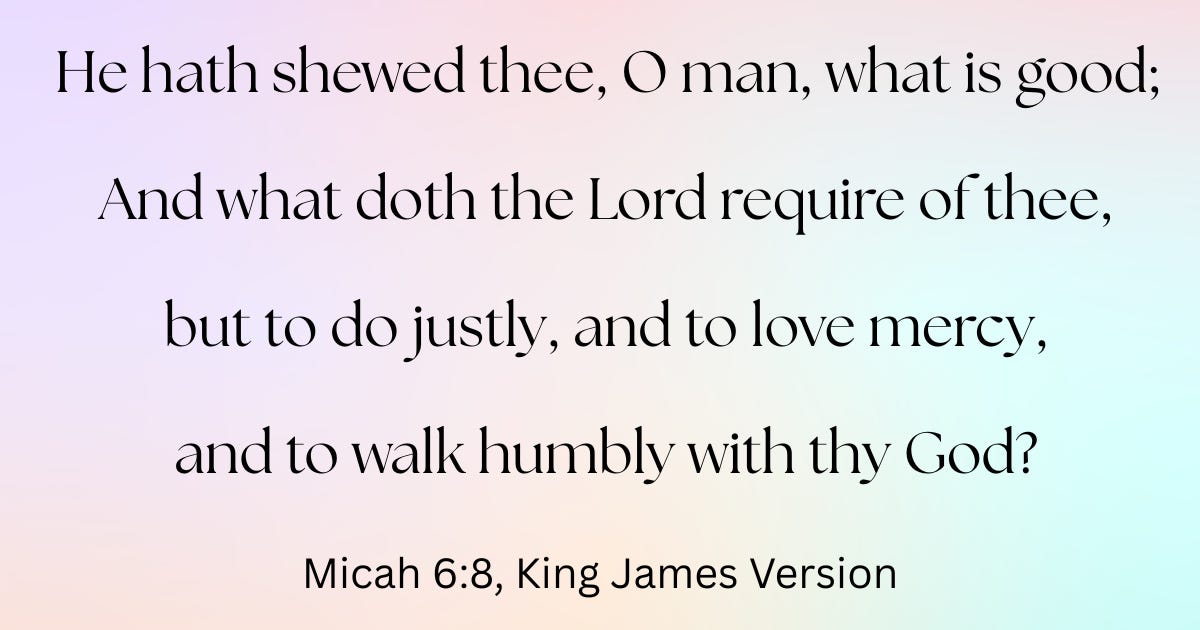
Where Christians are told to behave justly and with mercy, kindness, humility, and lowliness, we Jews are told to act within the law, and within that framework to act with goodness and modesty. The issue is what the original Hebrew words mean. Humility in English means believing one is not enough and knowing one’s lowly place. In Hebrew, ענוה means understanding your place as it relates to the subject, with the connotation of meekness. This is the word used with Moses when the Torah says “Moses was the most humble of men.” Micah 6:8 uses the word for modesty, צנה , which has the connotation of not drawing attention to oneself. Hebrew has two other words for humility: one means submission and subjugation; the other means lowliness.
In the United States, according to several prominent on-line dictionaries,ii these words are used as below. The differences between these and the Jewish meanings are, I believe, profound.
Justly and Justice
The root of the Hebrew word for judge is שפט ; the word for justice is משפט and means objectively applied, even-handed legal justice. Micah understood that God, through the Torah, says that formal, impartial, court-based justice and the laws of society based on the formal law are the foundation of civil life, with goodness and modesty, as explained below, being the means of carrying out the law.
But this is not the Christian definition. A Christian lawyer J. Rochyby, writes extensively on this subject. In an essay published on his website he says, “The biblical text emphasizes this difference, suggesting that merely being preoccupied with the idea of justice differs from the biblical call to do justly, as highlighted in Micah 6:8.”iii
Like many Christian writers I’ve read, he calls the Jewish focus on laws “legalistic,” which means, as he says, being preoccupied with the idea of justice. The Longman Advanced American Dictionaryiv defines legalistic as too concerned about small rules or details and not concerned enough about what is really important. However, law without minor details is a sledgehammer that smashes everything in one blow. It is the minor details that give it its beauty.
Christian writers and thinkers with whom I’m familiar use legalism as a criticism, sometimes even condemnation, of Judaism. They see the Jewish concern with God’s laws as choosing a set of limiting boxes into which we Jews have pushed ourselves, constrictions that limit our ability to meet changing needs, enjoy life, or reach the salvation that the Christian path offers. The underlying question defining this difference is, Do I want to follow the details of the law, or do what feels good? Traditional Jews trust that what God wants is for the best, even if we cannot see it. We want to do His will, thus we want to follow the details of the law. Christianity is much more feelings-based: I will do what feels right.
Rabbi A.I. Kook (1865-1935), first Chief Rabbi of what became modern Israel, studied history and philosophy through the eye of Judaism. In his essay, “The Way of Renascence,”v he writes of the founder of Christianity: [Jesus] was so taken with his soul current,vi and captivated thereby his followers, that eventually they lost the Israelite character and were alienated in deed and spirit from their source. His meaning is clear: the focus of Christianity and that of Judaism, although based on the same sources, are very different. Christianity focuses on positive emotions, offering a path to a happy life and individual salvation—a heavenly future after life in this “vale of tears” ends. Judaism focuses on building a civil society based on laws that are applied dispassionately to all.
The New Testament includes many valuable quotations that have helped countless people turn their lives to a positive and productive direction. Their value cannot be denied. However, as Rabbi Kook points out, these sayings are alienated from their roots. Many are nearly direct quotes from Pirke Avot--the Ethics of the Fathers,vii and others are from King Solomon’s biblical books Proverbs and Ecclesiastes. Christianity focuses on feelings of holiness and the belief that accepting Jesus will open the gates to the next world. Judaism focuses on creating a just society in this world through a series of laws teaching us how to behave to each other and to God, which includes applying those laws evenly within the parameters of the law.viii
Jewish law is absolute, with no place for compassion. Compassion is separate and can follow after the legal decision is made. It is written that when King David judged according to the law. If the law said that a poor person in X situation must pay a richer person money, King David ruled that the money was owed. But after the trial ended, where he believed compassion was warranted, he sometimes “put on a different hat” and gave the poor person the money to pay.
J. Rochyby, well versed in the Christianity, differentiates justly and justice this way: Justice is defined as fair behavior or treatment, embodying qualities such as integrity, honesty, and compassion. However, justifying behavior can occasionally veer toward rationalizing moral failings…’Justly’ refers to actions conforming to the law or ethical standards in a fair manner.ix In this definition, both justice and justly refer to actions; he specifies that ‘justly’ means actions based on the law. But Christianity is not based on God’s laws as set out in the Torah. It is based on the subjective behaviors elicited by Christian translations of biblical law.
The secular American world, based on Christianity, follows Rochyby. And this has been a big problem for the way Jews and Judaism are perceived in the world.
Continued in Part 2
Thanks to Scott Stephens, whose substack, The Quiet Warrior Life, always leaves me with new ideas and new ways of looking at old ones, and to Sim Zacks, for his careful critique and long discussion that helped me make this better.
i Stephens, Scott, https://quietwarrior6.substack.com/p/honor-is-the-divinity-within-you
ii In writing this, I referred to the on-line Merriam-Webster, Cambridge (both UK and USA), and Dictionary.com definitions.
iii Rochyby, J., Is Justly the same as Justice?, updated June 4, 2026, on Rochyby’s website, Rochyby Law Office, https://rochybylawoffice.com/is-justly-the-same-as-justice.html, accessed July 23, 2026.
iv Longman Advanced American Dictionary, Pearson Education Ltd., Harlow, Essex, England, 2003, p. 817.
v Naor, B., ed., When God Becomes History: Historical essays of Rabbi Abraham Isaac Hakohen Kook, Kodesh Press, New York, 2016, p. 71.
vi “Soul current” means the emotions that his soul drew him to, and which he therefore emphasized in his teachings.
vii Pirke Avot is a short, pithy book of wisdom pulled from the Mishneh, the main text of the Talmud.
viii Judaism has laws that apply to different groups. Two groups are the cohanim and leviim, who both worked in the Temple, and yisrael, or everyone else; even today these three groups have different roles and rules, particularly in the synagogue. Men and women, children of different ages, slave and free, and rich and poor all have different laws, roles, and requirements. These categories involve some of those “fussy little legal details” written about above. Within these groups, the laws must be applied evenhandedly.
ix Rochyby, op cit.